Saturday, October 20, 2007

Introduction


When I first became a fishkeeper and started off my aquarium, I was shocked. Quite literally, stunned by the amount of information, maintenance and perseverence needed to start off a succesful freshwater tank (Tropical marine fish? - nice species, but very costly and double trouble). It is hard. It is harder when all the fish bloody die, but honestly it is worth it, and I well tell you why.

When I started off, I was given the tank as present. Tropical fish? yeah they're something different, goldfish are boring I'm going for something exotic. Tropical fish that'll be a laugh. Fill in the tank, make it look good and chuck 'em in, they'll swim around and hey - presto! Easy, no problem. Oh no. I dont think so. Anyone who has a tank is chuckling, and rightly so. Its not that easy, my friends. Why? Heres a few examples:

  • Water: You don't want to chuck in raw tap water in, especially when starting an aquarium. Tap water is fine for me and you, but tropical fish and chlorine, chloramine don't mix very well. Also you can't just chuck the fish in all at once, ammonia levels may rocket and - dead fish swimming.
  • Got the right species? Some are small, some are big and you have got to get the right fish for the right tank.
  • Are the fish healthy? The diseases are, let me say, exotic and must be seen quickly and cured, with medical help. These are just a few basic examples, and it is hard. But these are just warnings. If you follow my guide, there's no reason why anyone should not have a healthy, relaxing, beautiful looking indoor aquarium.

    Setting up a aquarium

    The good thing about starting up a tropical freshwater tank is that its the best system for a beginner, because its relatively cheap and the fish are quite hardy. Saltwater fish are very expensive, and you will need a lot of knowlegde and technique.

    When you have bought a tank you must remember these points:
  • Wash the gravel: Put it in a bowl, place it under a running tap and keep stirring the gravel until the water that flows from it becomes clean. Really get in there and nead that gravel, get it as clean as possible.
  • Decorating material: Wash the rocks as well. If you have a background secure it firmly.
  • Clean the tank: Clean the tank, check for leaks, then empty it.
  • Everything is correct: before you fill in the tank, check that everything is right - filter, heater, light, thermostat.
  • Knowledge: I bought several books when things started going wrong, and I recommend that you look extensively around other Tropical Fish websites as well.

    Now that you all ready to jump on the bandwagon, these steps should help you:

  • Add the gravel: Make sure that theres enough, because the plants will want to root. If you want an underground filter, use at least a depth of 5 cm at the front and rising to double at the back.
  • Add the water half way: Now you can add any plants easily. Best to put the taller ones at the back, but its all in the eye of the beholder. Make sure that the plants have enough gravel to root, and cutting might be needed. Don't disturb the gravel, use a plate or an object to weaken its force. It is probably best if you use a hose.
  • Install the filter: Attach it so no plants or rocks are in the way. Attach heater and thermostat firmly.
  • Add the rocks: If you use a large rock, make sure that it is firmly bedded in so that it can never topple other.
  • Add the water all the way: Watch out as well, because if you fill it right to the brim, then later you want to change the arrangement and put your hands in - whoops!
  • Important!! Condition the water: Before adding any fish, you must get rid of all the chlorine from the water. Chlorine/Chloramine can damage the fish , and there are a lot of "tap water conditioners" on the market, so buy one NOW!!
  • Turn it on: Set up you lighting system if you have one, You should get a noise and a flow of bubbles when you turn the filter on, and then to a more steady flow. Before adding any fish, let the filter run for 5-7 days, so any last chlorine can escape. Also, you may notice that there maybe a lot of bubbles clinging to the glass - this is because tap water is pressurised, and as cold water is warmed and left in the aquarium, gasses are released. Let these dissipate, as they will disappear when aerated. Its not a bad idea to add a couple of flakes without the fish, to start off the Nitrogen Cycle before your fish arrive. Even better, take some water from an established aquarium, and plonk it in. If you can "nick" some media (gravel, decor, plants) will all be helpful. There's no fixed limit there, as this will get the cycle going. If there are sick fish in it, obviously try to find different water. Also, "running in" a new aquarium in an established tank, will colonise it with beneficial bacteria. There is always the option of a "fishless cycle", where ammonia is added to the aquarium. Make sure that the temperature is correct, at about 24C.
  • Add the fish!!: Add only a couple of fish to start off with. Use the Equalising method, by floating the fish using their bag. Leave them there for 15 - 20 minutes. Then release them.


    Things you can use


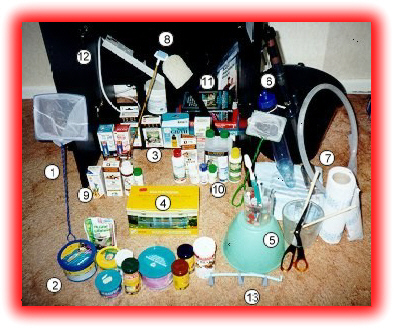
    1) Net: Very useful, for obvious reasons.
    2) Food: Don't run out, the fish wont be amused.
    3) Test Kits: Checking the PH, Hardness and Toxins levels in your aquarium is always useful.
    4) Nursery/Breeding tank: Useful to isolate a sick fish, pregnent fish, or fry.
    5) Water bowls: Cleaning the filter(foam, Carbon granule, Bio-max) where I use a litre of aquarium water, as using tap water destroys any useful bacteria.
    6) Gravel vacuum: There it takes the water out discreetly, not stressing the fish.
    7) Bucket, Towel, Tissues: I have a marked bucket (Litres), useful for water changes. Quick dry of the hands, watching for electrical socket etc.
    8) Algae scraper: I have a scraper and a stiff sponge, both are efficient at removing algae from the water.
    9) Fish Medication: You are bound to have one or two diseases in your aquarium. Always stock them away from sunlight and in a cool place. Salt can be used.
    10) Books: These days, knowledge is power. Well alright, maybe you won't become Prime Minister because you know everything about the fish hobby, but buying a good fish book would be invaluable to you.
    11) Drip loop: Look in "Hints and tips" page about the Drip loop.
    12) Air pump: Not the actual pump of course, this long tube is placed in your tank and helps aeration. A airstone can be used. Check out the page "Aeration and Filtration" for more details
  • How to remove snails from your aquarium

    How to remove snails
    from your aquarium

    Although these ‘common’ snails do not do any real harm to your aquarium, they can become very unsightly and reproduce at amazing rate. They tend to feed on leftover food and sometimes plants as well. On the other hand they aerate the sand preventing dead patches that may cause the roots of your plants to rot.

    There are many ways to remove snails:

    1. Spend a little time every day, once you first find the snails, pulling them out by hand. If you crush their shells many fish will swarm over to eat the dead snail. Or you can just throw them away.

    2. My least favourite method is the addition of copper to the tank. Copper additives can reduce the snail population, as the element is toxic to most invertebrates. As an alternative to a copper based medication, some people will add pennies to their aquarium to increase copper levels. However this can be dangerous to your fish since you do not know what might be on a penny. Only use related medications as a last resort and also remember to remove the carbon from the filter when adding any medication.

    3. Snail eating fish can also be helpful. Freshwater puffers (most of which are actually brackish water fish and need a little salt in their water and are typically very aggressive) will eat snails, as will some cichlids, and most Botia. The Clown Loach, Yo-Yo Loach, Dwarf Checkered Loach, Skunk Botia and the Bengal Loach are all Botia that may be found in a community tank and will eat snails. Remember when adding a fish to the tank to help with a problem like this that the new fish does contribute to the tank population. You could also add an apple snail that will do the same thing as the other fish if you do not have the size tank for a loach or a puffer

    4. Possibly the best and most favoured method to remove snails in larger groups is tempt them with food. After the lights go off for the night and the tank is dark, place a jam jar on the substrate at the bottom of the tank with a piece of lettuce or cucumber in the jar and leave for a couple of hours or overnight. When you come back there will probably be several snails attached to the food in the jar. Remove the jar with the snails and throw away. Repeat over a couple of nights and remove whatever snails you see and you cannot go far wrong. You can similarly use spinach, scallions (green onions) or other fresh vegetables to do this and it is useful to anchor the vegetables to the bottom of the tank using, for example, a lead weight.

    Basic Water Chemistry

    Basic Water Chemistry

    1. Soluble chemicals
    OK, we'll start at the top. Everything you're dealing with in a tank of water is to do with ions. Ions are either atoms or molecules of a chemical substance which have an imbalance of charge so that they're either positive or negative - how an individual 'species' (general term for an atom or molecule) behaves depends on what it's made of. Most chemical compounds split into ions in water and this is how they become dissolved - Intact species can't exist in solution but ions can quite happily interact with water molecules due to their charge.

    1.1 Water ions
    As well as the chemicals you put in, water also does the same thing. At any one time, a small proportion of a body of water will be split into H+ ions (positively charged hydrogen) and OH- ions (negatively charged oxygen with a hydrogen atom attached to it). These are what allow other chemicals to dissolve. Which leads us on to...

    2. Acidity
    First, let's dispel a myth. There isn't really any such thing as alkalinity. The term alkalinity is an academic crutch for describing a substance that is less acidic than pure water. Everything should really be considered in terms of acidity.
    Acidity is quite simply the proportion of H+ ions in a solution. Its common notation, pH, means just that - proportion of H. Water has a pH of 7, which corresponds to 10-7 ppm, or parts per million of H+ ions. This assumes that the water is at a fixed temperature and pressure and is completely pure - pH can vary enormously with even tiny changes. Even distilled water on standing in air will become slightly acidic as carbon dioxide dissolves into it.
    Some, or indeed most compounds when they dissolve in water will change its pH. What happens is that the positive ions of the compound will interact with the OH- and H+ ions from the water and so change the dynamic between H2O species and its ions. The upshot is that the body of water will produce more or less of its own ions to restore the balance.

    2.1 Alkaline minerals (Bases)
    Yes, I know, I know - I complain about something then adopt it myself in the same article. Still, it's a convenient reference to materials which increase pH. This sounds like an odd contradiction as when pH increases, the acidity decreases. In simple terms, alkaline minerals, or Basic minerals, remove H+ ions from solution. The common ones, carbonates, react with the hydrogen ions to produce carbon dioxide, which is released, and water, which returns to the system. As this happens continually it lowers the proportion of H+ ions in the solution and hence, the pH rises - the solution is less acidic than water.

    12.2 Acidic minerals (Acids)
    And correspondingly, we have acids. Acids release H+ ions into a solution. A good example of this is the nitrogen cycle, explained in detail in the wonderful article by ParrotFishRule. Basically, the chemical processes that convert the nitrogenous wastes release H+ ions due to the fact that they use oxygen ions from the water - leaving the rest of the molecule - H+ ions - behind.


    3. Hardness
    Hardness is a rather complicated area dealing with the quantities of different types of ions dissolved in the water. Of the two types, there is General Hardness (GH), which refers to the total quantities of ions dissolved in the water and Carbonate Hardness (KH - the standard adopted is German, in which 'carbonate' is spelt with a K...) which deals with the proportion of Hydrogencarbonate ions, HCO3-. General Hardness is also referred to as Permanent hardness because it's very difficult to change. For the purposes of aquaria, it's best left alone as the only safe and reliable method of changing it is 'cutting' with pure water. Carbonate hardness however is extremely important...

    3.1 Buffering
    Carbonate hardness is important because it dictates your tank's Buffering Capacity. Buffering capacity is the ability of a given body of water to resist changes in pH. Because the hydrogencarbonate ions in the water are a base, they can react with H+ ions and remove them from the system. With a given value of carbonate hardness, your water will have a fixed pH, but how much that pH will change when new chemicals are introduced depends on your buffering capacity. If the amount of new H+ ions released by the chemical is small compared to the amount of carbonate hardness, the pH will remain relatively constant, which is what you want. If the carbonate hardness is low, a small amount of new acid will make a large change to the body's pH.
    In general, carbonate hardness is produced by your water coming from an area rich in chalk and/or limestone, which releases Carbonate ions into your water. Such water will normally have a high GH and KH, and will also tend to have a higher pH. Areas which take their water from reservoirs rather than groundwater, or are on clay or peaty soils, will tend to have a lower GH and KH, though in this case GH may not change much while KH is reduced by reacting with the acids in the soils. This water will also tend to have a low pH and a low buffering capacity.

    MARINE SYSTEMS - BEGINNERS INFORMATION : Part 1

    MARINE SYSTEMS - BEGINNERS INFORMATION ~ WHAT YOU NEED!


    What do you need first??

    Thats easy - its information, get informed before a drop of water hits a tank, decide what you want to keep, is it going to be fish only? or maybe coral only or possibly a full reef as this will decide what equipment/lighting you should be aiming for..

    A marine tank cycles in different ways to a freshwater tank, we predominantly use live rock ( which is rock taken from the ocean) and live sand to help not only cycle the tank but also process waste products on a constant basis, if the tank is stocked with approx 2lbs of live rock per gallon it should be able to cycle out most nitrate that the tank produces if the tank is stocked at a reasonable level.. plus a marine tank will go through many different cycles, they usually come as ammonia-nitrite-nitrate, diatoms-algae-hard algae( corraline algae).
    This last stage of diatoms to algae can take some 6 months, especially if water conditions are bad or cheap sand is used as the free scilicates in cheap sand will feed the diatom bloom for many months..likewise with the algae stages, if water quality is less than perfect then algae will be a big problem possible for years until the source of the food is discovered.
    Lastly we have hard algae, this is desirable and a sign of a healthy tank, hard algae comes in a range of colours from pink to red and purple etc


    F ish come in all different shapes and sizes, nearly all marine fish are classed as delicate, obviously there are a few that are hardier than others but they cannot and will not suffer bad water conditions or cycling tanks, therefore just chucking in a few damsels and thinking that they will do ok isn't usually the case, that's why we use live rock as a cycling agent.
    T he general rule for stocking is about 1" of fish per 3 gallons for fish only systems and 1" of fish per 5 gallons of water for reef systems, obviously this isn't a rule that's hard and fast, if you have a thin bodied fish that's 3" long vs a fat fishthats also 3" long the fatter fish is going to produce more waste, so a bit of common sense must be used when selecting fish or deciding on stocking levels.


    Salt
    once again a big section of your tank will be influenced by the salt you use, there are
    many brands available, i have tried some of the cheaper ones as well as the more expensive ones and there is very little difference in the top end of salts, but a big difference in the budget end.
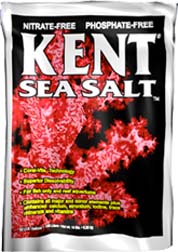
    I would personally recommend either kent

    instant ocean http://www.petdiscounters.com/small_animal/reptile/hermit/io_salt.jpg


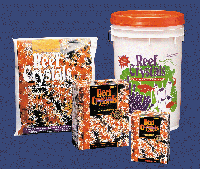
    or the best i have tried is reef crystals
    obviously as with most things in life if you buy in bulk it will be cheaper, i have found it better to go for the 55lb drums of salt and save about 40% on the cost of i bought it in small bags.

    Mixing salt is done differently by everyone, i like to mix my salt in a spare tank/waterdrum as when first mixed the salt is very caustic, if you are just starting out and the tank is TOTALLY EMPTY then yes you may mix the salt you need in the tank, get the temp of the water to 26c ( or the hydrometer wont work properly) then add salt till you hit about 1.015, leave this mix for 24-36 hours as different compounds in the salt mix at different rates, after 36 hours all the compounds should have mixed well and you can retest the sg.. normally it will stay the same but it may have increased in that time as all the salt mixes into the water, then slowly add salt til you read 1.022 and stop there, wait another few days with a powerhead circulating the water, the ph will be quite high when the salt is first mixed, and it also can give a false reading for ammonia when just mixed as well so don't be alarmed if you notice this.
    The tank should now be ready for rock and live sand.
    mixing salt for water changes..
    a little forward planning is usually needed for waterchanges on a saltwater tank, most keepers know when a water change is due and will plan a day or 2 ahead making ro water and pre mixing to prevent problems.
    S alt mix for water changes are usually done in spare buckets/rubbermaid tubs or any food grade plastic containers, the salt is mixed in exactly the same way as the first time you did it, get it to temp then add the salt, check the salinity of the new water against the older water that's in the tank to check for compatibility, once they are identical leave the new mixed water for a day or 2 and keep a eye on its ph, once the ph of the new mixed water is stable its safe to use( usually 48 hours, but maybe more for amounts of 50 gallons and above)

    Lighting
    Your lighting will determine what you can keep in the tank, and opposite what you want to keep will determine what lights you buy, light is not only used to view the fish etc, but its also used as a food source for corals, so the lights must be powerful enough to supply the demand of what you wish to keep.
    normal output tubes (n.o) will suffice for fish only systems, soft corals will demand either a small bank of several n.o tubes or a few high output t5's as these deliver more light per watt than a n.o tube will do, hard corals will demand either a large bank of t5's or the high end of lighting which is halide lighting.
    tanks are calculated on depth for the amount of light needed to penetrate the water, for every 100w of halide light supplied the penetration is approx 12" so a 15w light tube is really only going to penetrate about 3-4" as far as supplying lighting for food goes.
    the spectrum of lighting is also important, freshwater tanks use anything up to 6500 kelvins, but a marine tank will suffer massive algae and look washed out with such a yellow light, marine tubes are generally 10,000 kelvin's in temp which give a crisp but not yellow light, for a deeper look to the tank then 14.000k or 20.000k tubes/halides are used( or a combination of all), this isn't just for appearance the bluer end of the spectrum is used for corals to convert sugar into food more than the whiter end, therefore if you do use 6500k tubes then you must supplement the tank with 50.000k dedicated blue tubes.

    Other equipment needed are the same as any other fish tanks, a good stand, heaters and testing equipment for salt water especially concentrating on high end ph, nitrite, nitrate, ammonia are essential, after that calcium, magnesium and iodine aren't so essential but good to know where you are at...

    Flow
    Flow is mainly produced by means of power heads, reef tanks have quite a bit of flow to not only stimulate the action of waves but the added flow also helps with water quality, as the more water is pushed by and through the porous live rock the faster it will be able to process waste products.

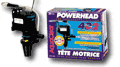
    this is a standard type of power head -

    How many are needed??
    this all really depends on what type of tank you have, a fish only tank will have substantially less flow than a reef tank, especially if there is less rock in the tank as any structure will dissipate flow quite considerably so additional pumps may be needed to stop any dead spots from forming within the tank.
    as a general rule of thumb its good to try to cycle the whole tank's gallonage every 10 mins through power heads..sometimes this will need to be increased depending on the structure and layout of the tank..

    Mechanical Filtration
    Marine tanks are usually very well filtered, this is usually done by skimmers but some keepers like to use some form of mechanical filtration, any type of filter can be used but its good to remember that any floss or filter material should be rinsed in TAP WATER every 3 or 4 days to kill the bacteria thats living on them, otherwise they will become biologically active and start to produce nitrates in massive amounts, with obvious results..

    Chemical Filtration
    T his form of filtration is used more often than any other, products such as rowaphos or carbon are used to add a sparkle to the water and to remove impurities and phosphorus from the water.
    products like rowaphos can be kept inthe water continuously and need only replacing when algae returns or traces of phosphorus are detected in tests.
    carbon must not be used all the time but in blocks of 2 weeks every few months, this is to stop it from releasing any impurities it has absorbed, and to stop it from releasing phosphorus as most carbon is produced from coconut husks which has a very high amount of algae producing phosphorus..

    Live Rock
    1 what is it ??
    2 what does it do ??

    well now for the bit that is totally different to freshwater systems, a freshwater tank can only cycle ammo-nitrite-nitrate with water changes used for removal of the end stage, a marine tank filtered with live rock will cycle ammo-nitrite-nitrate-nitrogen gas+consumption due to anaerobic bacteria in the cores of the rock, this alone stands a marine tank alone from all others, the ability to cycle nitrate is a massive boon and is something that most fish keepers will stock their tanks with rock for alone irrespective of all of the other benefits.

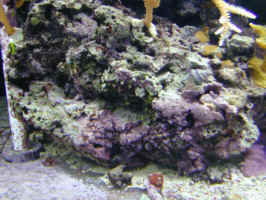
    Live rock is large hunks of rock that have been taken from the ocean, it is not only full of billions of bacteria spores, but also home to thousands of small critters/hermits/sponges and tube worms..in fact the list of life on them is massive, this is why we pay so much for hunks of rock that look dead.
    there re 2 types of live rock available to you, the first is uncured, this has just been removed from the ocean and contains alot of life but also quite a bit of dead bacteria and critters that didn't make the flight over to this county, so it is going to be quite raw and produce a bit of ammonia when added to the tank..
    cured rock is the second type available and as the name says it has had time to sit in vats of water and get rid of the ammonia that its going to produce, this rock is a little more expensive simply cos that lfs has had to keep it for longer and spend cash on salt etc for water changes..
    if you use sufficient amounts of live rock ( up to 2lbs per uk gallon) then mechanical filtration isn't really going to be needed, the rock will do it for you as long as there is sufficient flow in the tank and it is cured to a high degree, the bigger the pieces of rock the better its ability to denitrify, but sadly the more expensive it is as well...
    geographical types of live rock..

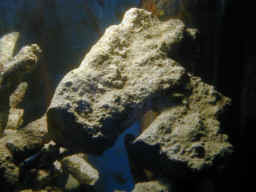
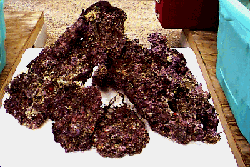
    This is florida base rock -
    its quite dense and liiks alot like concrete, this rock is too dense to be useful for denitrification as the water cannot penetrate but its useful for building bases and saving cash if all live rock isn't wanted or if your stocking a very large system.

    Fiji rock is one of the most common and best rocks to get, its full of nooks and crannies where life can emerge and is great for filtration -
    it can come usually as small cannonball shapes but sometimes is available as thinner flat pieces, great for making caves.

    Eco System Rock
    This is the new craze, when eco warriors complained about the amount of rock used in the aquatic trade thats taken directly from the ocean, a new trade developed, and that was to make your own rock, this is then shaped using a concrete base and cured for many months in varge vats. its available in some outlets but isn't considered live rock unless its been allowed to sit in a active system for some time, useful again to use as a base rock -

    MARINE SYSTEMS - BEGINNERS INFORMATION : Part 2

    MARINE SYSTEMS - BEGINNERS INFORMATION ~ WHAT YOU NEED!

    Filtration
    This is one of the biggest parts of the tank to get right, filtration in a marine tank should make the water so clean that you could drink it( apart from the salt--dont try this at home lol) in a freshwater tank there is a definite cycle of ammonia-nitrite-nitrate, but in a marine tank we are able to go another step and process nitrate to its gas form, by using anaerobic bacteria and understanding what conditions this bacteria need to thrive will result in a virtually nitrate free system and its completely natural.

    There are many styles of filtration, here are the most common.
    under gravel filtration.
    Almost all of us are familiar with u/g plates etc and we all know how they work, i used one in my freshwater tank for 6 years with no problems, in a marine tank they do work but require more maintenance than normal..which due to human nature is sometimes missed, water quality starts to spiral downwards and as we all know only bad things happen quickly.
    Reverse flow u/g filters work a little better and tend not to gunk up too much, the sand bed must still be kept well stirred to stop clumping etc for the normal amm-nitri-nitrate cycle the u/g filter does well, but sadly its not capable of cycling the nitrate due to the high prescence of oxygen.

    Deep Sand Beds
    i wont write much on dsb's as i have a excellent article that explains it 1000 times better than i could ever cover.
    just to say that they are a very efficient way to cycle nitrate and to some level phosphate, and release trace elements back into the system through passive diffusion.

    Berlin System
    The berlin system is what most people tent to opt for, its the use of a skimmer and live rock to perform most if not all of the tanks filtration needs, a concentration of 1-2lbs of live rock is needed, and a good skimmer, after that there is no real need to purchase expensive external filters.
    The live rock will cycle a tank and carry out all stages of filtration, the only thing that's really needed to make the berlin system work well is flow, water needs to be pushed through the rocks in order for the bacteria to have access to it, it also lends itself to be combined with a deep sand bed for total coverage from all angles.
    This author uses the berlin method on his tank and i have had a problem with nitrate..the problem is im needing to add it!! my algae/coral zooanthelle require about 2ppm nitrate to live and function so i have started to add more liquid food simply for the nitrate content...

    Jaubert Style
    The jaubert style of filtration uses a thick layer of live sand on top of a plenum to provide a small void under the sand, this does a roughly similar job as the deep sand bed, encouraging anoxic conditions to be developed, anaerobic bacteria flourishes and nitrate is cycled at quite a fast rate
    plenums have sometimes caused a few raised eyebrows from some of the more experienced keepers, its low on maintenance but may need replacing every 8-12 years..i personally wouldn't ant to rip out a 12 year old reef to repair a plenum... but others swear by them..

    Cleanup Crew
    The clean up crew does exactly what it says on the tin. they are there to eat any waste food and keep the tank clean, plus they will happily eat the waste of other larger animals thus removing it from the water column and minimizing waste a real boon in keeping manual maintenance to a minimum and eradicating algae blooms that are fed by excessive waste, they can come in all shapes and sizes, from starfish to snails and hermits being the most common, most people buy the usual turbo snails etc but also try to look out for the more unusual like cerith snails and Nassarius Snails, these little beauties will not only eat wasted food and detritus, but they like to burrow into the sand and are excellent in keeping d.s.b's healthy and well turned over. a real treasure if you can get hold of them.
    Hermit crabs are comical with blue legs being a little better at cleaning up algae than reds but both are equally useful in keeping the tank maintained and clean, other than cleaning the front glass every few weeks there should be no real human intervention, your cleanup crew will do it all for you if in sufficient numbers... which leads nicely to clean up crew stocking, general rules tend to vary but try to aim for 1 clean up species per 1-3 gallons of water and 1 starfish per 50 gallons or so.
    A quick word of warning about mixing snails and hermits, if the tank becomes very clean ahd the hermits get hungry they will opt for a nice snail takeaway so every few weeks feed them with a small piece of meaty food, such as mussel or lance fish to keep them happy, plus ask your lfs for a few empty shells so they wont also kill snails to steal shells as they grow.

    Sumps
    A sump is a smaller tank either kept to the side or the bottom of the main tank, it allows a area to put all of the less attractive equipment such as heaters/skimmers etc etc out of sight, and also if enclosed in a cabinet it reduces noise.
    the main tank usually has to be drilled in the base with overflow weirs or at the sides/back at the required water line to accept pipes that will lead to the sump, the sump itself can be just a box or it can be partitioned to allow a area for growing algae's to compete for nutrients or if lighting is sufficient a area that baby corals can be grown on in relative safety from fish etc.
    The main reason for the sump however is it increases the gallonage of the system, allowing you to have more fish in the main display without being overstocked.
    a return pump is then used to return the water to the tank as required
    refugiums, i thought id tack this 1 onto sumps cos that are somewhat linked, a refugium is a small area that is safe from fish/inverts etc that will eat them, it can be as simple as a box under some small rocks made of eggcrate, or as complex as a separate tank full of algae that allows them to breed and be safe, they will swim into the tank in a few days and be eaten as they do, but their numbers will always be high if well fed, they are the best live food available so if space allows a refugium is a excellent idea

    When things go wrong
    Ok this isn't a totally risk free hobby, things do go awry and mistakes happen, short of a tank rupture things usually can be recovered in time.
    some general things that tend to happen are things like poor water maintenance, not maintaining equipment or overfeeding usually are the root cause to much heartache.
    water maintenance:
    your water is the life of the tank, if its goo then you can almost bet that everything else will also be good, if its bad then your in for a rough time, in a new tank test every 3 days for main water parameters, including ammonia, nitrite, nitrate, ph and specific gravity( s/g).. as the tank ages you can drop ammonia and nitrite from the list.
    Testing the water. most tests can be done at any time, ph should be done just before the lights come on and just before they turn off at the end of the day, as photosynthesis will raise ph ( also see algae control for methods in controlling ph swings)and knowing what the tanks swing is can be very useful, the ph can drop if the tank is becoming acidic, fish waste is acid based likewise so is the co2 they produce, good surface movement will help these gas off naturally and is a main reason why tight fitting cover glasses aren't used.
    water tests are the backbone to finding out what may be wrong, many times people say "i have lost my fish" and i reply what are your test results? usually the reply is " umm i don't know" if something looks ill, the tank looks different, the corals or fish are acting strange or not showing that well you test test test!!!

    Algae is a main reason for heartache in the tank, it can plague tanks for many years, usually if they keeper is using tap water with residual nitrates or there is phosphate present in the water then algae can last forever.
    Getting rid of algae
    Most people overfeed, resulting in excessive waste and bad water, just cutting down on feeding can solve many problems, incorrect lighting or bulbs that are a few years old will also feed enormous algae blooms as the light spectrum shifts to the redder end algae will thrive.
    Increase the clean up crew, make them scavenge for those leftovers that are missed and improve water quality, make sure all filters/skimmers are working well, some may need a clean out or a rinse in tank water.
    manual vacuuming of the substrate shouldn't be needed, that's the job of the clean up crew.
    Algae blooms in one area of the tank would denote that something has died in that area, releasing nutrients into the water and causing a local bloom, sadly that the time to start looking under rocks to see what the unfortunate victim is and remove it if possible.
    valonia is a bubble algae that some suffer from ( myself included) small porcelain crabs will eat it, but its best not to introduce it if possible, if you purchase anything from a lfs that has small green bubbles of algae on it remove them outside the tank before introduction.
    Slime algae. this usually plagues new tanks and new keepers, its a mat forming red/greed algae that smothers everything in a new tank, usually it will go away as it consumes whatever is feeding it, but sometimes its persistent, 1 golden rule is slime algae hates flow, if you have it increase flow to the whole tank as well as the general area, it will peel off the substrate in mats and can be easily netted out of the tank once loose. it is one of the few algae's that is poisonous to both fish and humans, if you have been handling cyno or any slime algae wash you hands well afterwards.
    All nusciance algae's will go away if whatever is feeding them disappears, you can also cut down on light and introduce competition for those nutrients in the form of macro algae's, carlurpra is the most common algae that people use, usually in the sump( as it can become a pain) a small light on the sump will be enough to grow this algae and because its such a fast grower it will soon out compete any other algae for food, plus it gives the added benefit that if its lit in the sump at night when the main tank lights are off it will stabilize the tanks ph balance and stop really bad swings in ph during the nighttime a double plus!!!

    Disease.
    White spot (Cryptocaryon irritans)
    white spot is one of the most common ailments that will strike marine fish, in a marine system if the fish cannot be netted and placed ina hospital tank then its very hard to treat, as most medications contain copper which not only is toxic to all inverts it is also absorbed into the rock and re-released over long periods of time.
    One of the best methods i have found to not only treat ich but also prevent it is the common clove of garlic, it contains a compound called Allicin, this compound produces the smell we all know as garlic, its highly antibiotic and will also stimulate feeding in lethargic fish, you can use it by taking 1 clove of garlic and after peeling stab all over with a fork, let the clove sit with the food in some water for a good hour then remove it and feed as normal, or for a more powerful punch take a small piece ( baby fingernail size) and pound it into a fine pulp, the more the garilc is minced/liquidized the more allicin is released in the garlic oils, this canthen be fed to the fish in the same way as above but you don't need to remove the small pieces of garlic, most fish will eat them with relish. it has proven to be such a boon that kent now manufacture a product called garlic extreme which is just a liquidized garlic preparation.

    Velvet/rust (Amyloodinium ocellatum)
    This is a not so common parasite that presents itself as a golden/rusty sheen on the gills and scales of a infected fish, if left untreated it is usually fatal, infected fish will either die for no reason or if seen early they will flick against rocks and also cough to flush water over their gills.
    Treatment includes freshwater dips( very stressful and can cause ich) or chemical control in a isolated hospital tank

    Lateral line disease
    This problem condition affects certain species of marine fish, and those almost entirely members of the family Acanthuridae, Surgeon fish or Tangs. The appearance of the resulting damage from the disease is very similar to that of the Hole in the Head Disease seen in freshwater fish. But in Marine fish it will usually start off around the head area, and progress along the lateral line of the fish back into the body, scarring the fish as it develops. Neglect to feed the necessary elements of the food given to Surgeon fish is the primary cause of this condition, and only restoration of an improved feeding regime will allow it to control, and repair. The cure for this condition is not the complete answer, the feeding routine must also be addressed as tangs have a very selective stomach and cannot tolerate algae free environments.

    Osmotic shock.
    Most fish regulate how "wet" their bodies are through active osmosis, this basically means that they have the ability to pump water in or out of their bodies to match their current conditions, most oceans are very similar in levels of salinity, so normally this isn't a problem.
    The problem starts when we as keepers neglect to inform ourselves of the chemical composition of our tanks, the salinity, ph and hardness all play important roles, this form of infection usually presents itself if a fish/invert is placed in a bag at a lfs, then carefully transported home, the keeper then opens the bag and dumps the poor fish into the tank, the difference in ph and salinity between the 2 tanks may not be significant, but it usually is enough to make the fish pump out so much internal water (in a attempt to become more salty)that it dies of dehydration( this would happen if your salinity was higher than the lfs) or the opposite if the salinity is lower than the lfs the fish would start to suck in water to become "less salty" and match its environment, this usually causes internal haemmoraging and renal failure resulting in a slow and very painful death.
    inverts are especially prone to osmotic shock due the the hard exoskelleton which means that water takes much longer to diffuse inside its body.
    what can you do to prevent it??
    This is the easy part.. try to match your lfs water parameters if possible, make your tanks salinity,ph and hardness as close to theirs as you can to mimise shock, and always acclimatize well, float a bag with a new fish in for a few hours, adding 10mls or so of tank water to the bag every 10-15mins so the animal/invert/coral slowly becomes used to the new water chemistry, this may take a few hours of hassle, but it reduces almost all chances of shock, and stress induced disease like ich.

    Choosing a Tank and Stand, Hoods and Tank Tops, Locating the Tank

    Start at the Beginning

    Right, so you have decided to get a tank, and stumped for Tropical Freshwater (If you havent decided, there are also marine and coldwater forums to give you some ideas on this site). There are over 4000 species of tropical freshwater fish imported, from the americas, africa, asia and the australian subcontinent. These raise from the tiny to the colosal, timid to dangerous, plain to colourful, common to super rare, and everything in between. This obviously can pose some difficulties in trying to understand and provide the best conditions. The hobby can be as complicated, involving and expensive as you want to make it, from za single small tank in the corner of the living room to hundreds of tanks as part of a small business.

    Plus it can be quite fun along the way!

    Choosing a Tank and Stand

    OK, so your choosing your first tank. As with everything else in the hobby, there are lots of choices! Before commiting, some things to consider
    A) Are there any specific fish you want to keep that may require a tank of a certain size
    B) How much space do you have in the proposed location of the tank
    C) Do you want the tank to form a piece of furniture
    D)What are you looking to spend
    E) What shape of tank do you like (generally rectangle, bow front, corner, cube)


    Its generally best to get the biggest tank you can afford and sensibly accomodate, as these give more stable conditions, and allow for more fish. With increasing tank size, there are things to consider
    A) Bigger tanks cost more to set-up and run
    B) They can take more time to maintain
    C) Can you physically reach all parts of the tank
    D) They are harder to move and transport
    E) They weigh more! A Litre of water weighs 1kg, and considering the tank and stand etc, every litre of tank volume probably accounts for 1.3-1.5kg of weight. Tanks are heavy, and need a very stable floor surface. With tanks over 250 litres its worth considering the strength of the floor

    Right, so you have chosen the tank type and size you want. There are basically two choices, glass or acrylic. Acrylic is lighter, easier to handle, stronger, and can have better optical qualities. It does scratch easier, is harder to repair, and in common sized tanks its more expensive. In common sized tanks 99% of people go for glass.

    You will need something to sit the tank on. For small tanks (<100l)>

    What ever you choose to stand the tank on, a layer of polystyrene or specialist matting is essential between the tank and what its stood on, to even out any unevenness in the surface.

    Its always worth shopping round, seeing what different places offer (especially for cabinets), and comparing prices. Some bargains can be found on second hand tanks, buts a case of buyer beware, if in doubt dont risk it!

    Hoods and Tank Tops

    In addition to something to site the tank on, your probably going to need something to go over the top of it. Hoods and cover glasses keep fish in, air bourne chemicals out, provide somewhere to put lights (see later sections), stop water and heat loss, and improve the aesthetics of the tank.

    Its generally reccomended to have a cover over the top of the tank itself (such as sliding cover glasses or a drip tray) and a hood. The first the tank may come with, the second it almost certainly wont unless you buy a package. For hoods its worth considering looks, tank access, and the suitability for any special future lighting plans.

    Locating the Tank

    Once you have your tank, its time to check the location before setting it up. Some points to consider are:
    A) Is it near suitable power outlets? Tanks have a habit of using a lot of these, and you always need more
    B) Is it out of direct sunlight? Direct sunlight can cause problems with algea, viewing and over heating.
    C) Weight - is the floor strong enough and level? Checking with a spirit level might be a good idea, as stands can be levelled up before the tanks filled with water
    D) Is it in a good viewing position?
    E) Is it away from things like washing machines, or other equipment that may cause vibration, noise or airbourne pollution
    F)Is it sited where it wont be knocked or brushed past all the time? This can cause a risk to the tank, and annoy the fish
    G) Is it in a area of stable temperature? Fluctuating temperatures can cause problems with tanks, and tanks in very cold areas will cost a fortune to heat
    H) Whats its proximity like to sinks and drains for maintenance - trying to limit bucket carrying, as this also minimises wet shouty moments!

    Once the tank is set-up, its best to take 5 minutes to think it over befoe getting water in it, as it can be quite difficult to change!

    Choosing Equipment

    OK, so far we have a box to keep water in, and something to stand it on. In theory fish could live in this, but not for very long! As we are going to be maintaining a mini bit of aquatic biotope in our houses, some equipment will be needed to keep our fishy friends alive.

    This falls into three main catagories:- heating, filtration, lighting (more for us and plants and the fish), and "other". There are two main choices, either select individual bolt on items from different manufacturers to fullfil your needs, or buy systemised tank (such as the common Juwel brand). The second is easier, but may prove more expensive, and cut flexability. Its always worth shopping around for equipment, including on line stores as these often have big selections at good prices.

    When choosing equipment, it helps if you have an idea about any specialist equirements fish you want may have. If you just going for community fish and a standard set-up, then this shouldnt be too difficult.

    How to move a Tank

    I am writing this article based on moving the average tank of approximately 20 UK gallons running with an internal filter. I know many people have larger tanks, but as far as I can see the process is about the same, just scaled up a bit (a few more buckets required!)

    The first stage in moving a tank is to plan and be prepared. Work out exactly what you have to move, how far (and how long) you have to transport it, and where it will go at the other end. If you can work out a tank location before you actually move, it saves a lot of messing around and time wasting at the destination. Things such as availability to water supplies and power points need to be considered. There is nothing worse than setting a tank up only to realise that you haven’t got anywhere to plug the filters in!

    The next thing to consider is buckets for holding fish and water. Some people like to bag up fish for a move, but personally, I like to move them in as much water as possible. This allows more water to be taken to the new location and with a greater volume of water, the heat loss will be reduced. I would say the best tool for this is your standard black plastic dustbin (cleaned without detergents first). Another couple of buckets are also needed for gravel and plants.

    About a week before, its worth doing a slightly more thorough than usual gravel clean. This will save on having lots of gunk floating around when you uproot everything. As usual, don’t clean all the gravel, but maybe 50-70%. It will also allow your filters to compensate for any loss of bacteria due to having the gravel cleaned.

    First stage of the move is to siphon some water into a smaller (10-15ltr) bucket. Carefully remove all the plants (if you have any) and put them in this bucket. This is also a good time to remove unwanted snails where possible. Having no plants will make catching fish way less stressful for both you and the fish. Once all the plants are in, a bit more water (till the bucket is half full) can be added. I then recommend covering the bucket with a damp cloth or towel, as this will stop any leaves from drying out and help prevent spillages. Leave the tank for a little while to allow the filter to clear any disturbed gunk from the water.

    When you ready to move, siphon some more water into the dustbin (or similar) until there is enough water to hold the fish in. Internal filters can be placed in here, along with a heater stat. If these are fully covered by the water, they can be plugged in and turned on, keeping the water moving through the filter. Now its time to catch the fish and place them in this bin too.

    Once all the fish are caught, some more water can be siphoned off to fill the bin to about ¾ full. Be careful to watch for jumping fish at this stage. With all the fish in the bin, and with the filters still running, the bin is OK to be covered and left while the rest of the tank is dismantled. I use a bin bag (or any other sheet plastic) taped tightly over the top to cover it. This will stop fish jumping out, keep them in the dark (less stress) and stop spillages en route.

    If more buckets are available, then more water can be taken along. Just fill them up and cover them as before. If the tank has a fine gravel or sand substrate, I siphon the gravel and more water into another bucket. If the gravel is too large to be siphoned, then the gravel can be removed with a scoop or similar. The gravel bucket can have more water added to keep any bacteria present wet, and with more of a chance of surviving.

    The tank is now empty and can be cleaned (no detergents!) of any stubborn algae or dirt.

    Now all that needs to be done is to unplug the filter and heater from the bin with the fish in (leave them in the bin) and the whole setup is now ready to move.

    At the other end, simply plug the filter and heater back in, and fill the tank with gravel. Where any water was removed and thrown away, an equal amount of warmed dechlorinated fresh water can be added to the tank. I then like to mix (by adding the fresh to the bin and bin to the fresh) some of this new tank water and the old water in the bin to ease the transition and any temperature differences. After both the tank and bin water have been mixed, add much of the water from the bin to the tank. The fish can now be transferred over, and the filter and heater added and turned on. All the other plants and décor can then be added.

    Other variations:

    External filter: This will just have to be turned off at the last minute and reconnected ASAP at the other end.

    UGF: The gravel will need to be kept wet to preserve the bacteria for the biofilter.

    Air powered sponge filters: Can be kept running in the bin with a battery powered air pump.

    Long distance move: A battery powered air pump and stone would be useful to have running in the bin with the fish.

    You want to know about Filtration and Aeration?

    Filtration - whats the big fuss? Surely, all you have to do is install your filter and off it goes? Well, in essence that is correct, but its not quite as simple as that. You shouldn't need any technical skill to operate a filter, but it well help you if you understand how the processes work.

    The purpose of the filter is to remove dirty materials from the aquarium. With so much crap going through the filter, it is important to keep regular maintenance, as a neglected filter becomes a box of concentrated dirt through which all the aquarium water is continuosly passed. Also a impeller chamber can become clogged, and the fan will stop - hence no water will run. Eeek!! Don't panic just undo the cover and clean it, and it will work again smoothly.

    Filters work in three ways:

  • Mechanical filtration: Removes suspended materials from the water.

  • Chemical filtration: Removes dissolved materials from the water.

  • Biological filtration: Uses beneficial bacteria to convert toxic substances into relatively harmless ones.

    Ok, three ways of filration, thats not too bad. And if you want to know a bit more in detail, read on....

    Mechanical filtration: To strain suspended dirt from the water, a reasonably tightly packed material is required. This is a man-made substance like nylon floss or synthetic foam. i would recommend you to only buy foam designed for aquariums, as others may be toxic.

    Chemical filtration: The best material to remove dissolved solids is activated carbon. It has a large surface area, which readily soaks up dissolved minerals and chemicals, such as fish pee, on its surface (that process is called adsorption - remember this word and its use, you could impress you fellow tropical chum and its good to store this info). Also carbon will adsorb useful substances, such as medications, so it must be taken out when these chemicals are in use. After a peroid of time, the carbon becomes ineffect. When this happens it must be replaced.

    In the majority of systems, more than one medium is used so that mechanical and chemical filtration can occur simultaneously.

    Biological filtration: Is the most important, because it uses the bacteria to change harmful fish waste products, ammonia and nitrite, into a less dangerous compound, nitrate. Biological filtration requires a "running in" period while the bacteria establish themselves on the filter medium. This process takes a few weeks, and requires ammonia for the bacteria to eat, which can be provided by adding one or two hardy, robust fish until the nitrite and ammonia levels are stable. Low-maintenance, in-tank, biological filtration can be used in all aquariums. For more information see the page about the Nitrogen Cycle.

    Well, you might as well know about aeration and the uses of air pumps...

    Aeration: Power filters will do most of the oxygen enrichment, just as long there is sufficient agitation of the surface, and this will promote the exchange of gasses (Oxygen is absorbed, and CO2 is eliminated). With planted tanks, and there is a small fish population, even agitation is kept to the minimum, to actually keep CO2 in.

    Its best that the air stone is used for special reasons, as it isn't particularly useful. The air pump itself provides aerotion by compressed air, which is electrically driven (well I never). When choosing an airpump, it's size needn't be related to the dimensions of your tank - even the smallest model will provide enough air for a 60 cm long aquarium.

    Sorted? You know about aeration and filtration now? Good, if you still need info look around my site.

  • Eheim Filters - Keep them running well

    Eheim filters have been around for a very long time now and have a very good reputation for quality and reliability. Perhaps that sounds like a sales ploy, but it is true. Years ago I had what they now call Eheim Classic filters and they are still selling them.
    So now on to the nitty bitty bit, the problem solving part, of cleaning them and priming them. Hopefully some of this info can be useful for any other fish keeper’s using these excellent filters.

    First of all, those seals around the top, and where the pipes connect, keep them well coated in ‘Vaseline’.
    Next, when you are cleaning out the impellor make sure that all the grot is removed from the bottom and inside of the body that the impellor sits in. This is essential so as to keep the impellor cool and smooth running.
    When cleaning the head of the filter take great care to clean right down the little hole that is in the surrounding area. It is only small, and a lot of people miss this one out. It is there to allow water down to the bottom of the impeller body to cool it and keep it running free, but this hole clogs up in time.
    Next is the priming of the filter, which a lot of people have trouble with. Assuming that the filter is empty and clean, make sure that the outlet pipe is completely free from any water as this will stop the priming of the filter. (Even if there is water in that bit of pipe that goes into the tank, you know the bit that has the U bend in). Now leave off the outlet pipe which comes off the filter box and with all taps on (if taps are fitted) give the outlet a good suck, (a spare piece of pipe helps with this). Then when you hear that the water is flowing into the filter box, you can put the outlet pipe back on. Depending on the size of the filter you should have plenty of time to get that pipe back on, so don’t panic about it.
    Another thing that could cause a problem, is the gunk that builds up in the pipe. When you see that your green pipes are black inside, pull them off when doing the next filter clean and pull a long pipe cleaner through them. Doing this will keep the flow rate up.
    Keeping that Blue filter sponge clean also helps, as when this gets clogged it draws air in and makes the filter hiss.
    When you have started up your filter there will be, for a while a hissing noise from the pump. To clear this, give it a rock to and fro as this will allow the air to be released from the filter.
    Hope this will help, as all these things that I have written, all work for me and others that I have told about them.

    FAQ

    Q. What type of media do I use for a long-term biological/mechanical filtration?

    A. From the bottom of the filter box. Ehfimech, then Ehfifix Pad, then Ehfisubstrat and finally Ehfisynth Pad.

    Q. Why is it that my filter is not working as well as it did when I first bought it?

    A. Most probably likely to be a build up of algae/gunk in and around the impellor. This must be kept clean at all times, as it will in time wear out the bearing shaft. As the bushing gets old, it loses its grip on the shaft and allows the shaft to spin with the impellor. When this happens they both spin simultaneously and cause a reduction in flow.

    Q. What is the difference between Biological, Mechanical and Filtration?

    A. Biological - A build up of toxic nitrogenous wastes is a natural result of all aquarium inhabitants. In nature the large body of water is enough to dilute these wastes to be used up by other organisms and then be converted to a less toxic chemical. In the aquarium however these poisonous toxins cannot be converted without the use of a powerful biological filtration. Without this conversion from toxic to less harmful waste the fish will slowly poison themselves.
    If you use Ehfimech, which is made of hollow ceramic material and holds back the solid dirt particles (at the same time) it provides an intensive stream of turbulence in the water and an even flow of water through all layers in the filter.
    Then put the blue coarse filter pad in.
    Use Ehfisubstrat in the top basket. This consists of highly porous sintered glass, which is used as the main filter medium and has a huge surface area and allows lots of bacteria to colonise.
    Then use the white fine filter pad on top.

    Mechanical - This is where the filter works by trapping the particles of waste as they pass through.
    Again we use Ehfimech in the bottom layer to trap the solids and to allow an even flow of water through out the filter.
    Then in the next layer we use Ehfifix, which is a medium mechanical filter. This is placed between the Ehfimech on the bottom and any subsequent biological or chemical filter layers. This traps debris, which has passed through the bottom layer and acts as a divider.
    On the top we use Ehfisynth, this is a completely natural wool, and will trap any fine particles of dirt. It can come loose or in a pad.

    Filtration - Absorptive filtration is a process in which dissolved substances are captured by solid bodies such as carbon. These dissolved substances can be harmful to fish. They are generally of chemical origin such as chlorine in tap water. (Alkaline residues of aquarium medication and even some dissolved).
    With all types of carbon the effectiveness is short lived and to stop the absorption being washed back into the tank they must be changed. Also remember that if you are using any medication the carbon must be removed before any treatment can start, as the carbon will absorb the medication.
    Recommend Ehfikarbon, which is a high quality carbon is for short term use, and is to be used in freshwater tanks only. You still have to use sponges to trap the waste.
    The combination of materials is endless as you could make up your own if you like, as long as it does the job of keeping the toxins down and keeping the water clear, then that must be OK with us.

    Here is a list of Eheim filters recommended to run, XXXX size tanks

    Recommended filter for XXXX size tank

    2006
    12 - US Gallons
    2008
    8 – 16
    2010
    16 – 42
    2012
    53
    2048
    26 – 53
    2252
    From 53
    2003
    16 – 26
    2211
    40
    2213
    66
    2215
    92
    2217
    159
    2222
    40
    2224
    66
    2226
    92
    2227
    92
    2228
    158
    2229
    158
    2250
    264
    2260
    396

    So, as these machines are so reliable please don’t just run them into the ground. Just remember to keep your Eheim filter clean on the inside, keep the pipes clean and your Eheim will give you many years of reliable filtration.
    AS I have said at the beginning that the priming of these filters can be tricky and is one of knack.
    First make sure that the filter box is empty of water and also the outlet pipe is completely empty including the U bend that goes just in the tank.
    Next make sure that the filter tap is turned on at the outlet pipe and remove the outlet pipe. Put a piece of pipe over the outlet hole and with the inlet tap turned on give it a good suck. When you here the water running into the filter box put the outlet pipe back on and clamp it up.
    Then when the filter box is full then you can start the pump giving it a shake now and again to dispel any air that is in the filter box.
    Keep those pipes clean, as this will reduce the flow of water.


    The Nitrogen Cycle.

    Break-in period:

    When you have just started a biosphere it takes time to perform, unfortunately. Water placed in a new aquarium will be changed quite radically. It takes time for the aquarium to balance, to be able to remove all of the waste material (ammonia) to a less toxic substance (Nitrate). New aquariums generally take about 5 - 7 weeks to able to sustain a full biological load. Thats why you shouldn't just shout "Weeehay!" and chuck in tons of fish at once, it should be a gradual change.

    The Nitrogen Cycle itself:

    Fish go to the toilet, well, they don't really give a damn they just drop it anywhere, so because of that they add a lot of Ammonia. Its not just fish excrement, its fish respiration, excess food, plant remnants and even any dead fish that cannot be found. If you had a huge amount of water, the ammonia would dissipate quite well, but where you have a new aquarium ammonia tends to concentrate. This is a vulnerable time as no fish will enjoy such high levels, but some are tough (platys, barbs) and can withstand these levels. But your ammonia level is just a stage, as biological filtration and beneficial bacteria will reduce it, but it takes time to do this.

    To remove ammonia altogether would be bloody hard: instead, we use numerous bacteria that uses ammonia as a food source. The bacteria strain that is important is Nirosomonas. This strain needs time to colonise the aquarium, the desired population doesn't just happen overnight. This is useful as it absorbs ammonia, and reduce it to Nitrite.

    Once Nirosomonas have reduced ammonia to nitrite, beneficial bacterias isn't finished yet. Nitrite can be reduced further to Nitrate. The next step is the bacteria strain of Nitrobacter. Nitrobacter takes even more time to adsorb nitrite, and in this stage nitrite is prominent and it is another dangerous time for a fish, even a hardy one. But, after a while, nitrite levels have reduced and the less toxic compound nitrate is left. Although this toxin is far less dangerous than the earlier two, you must not let it build up in your anquarium. Standard water changes are a chore, but I would recommend you to do them as this reduces nitrate concentrations, and your fish will then be more healthy and will appreciate you for it!! (Well, maybe not but it can prolong the life of your fish). In technical terms, the Nitrogen Cycle process is called Nitrification - the oxidation of nitrogen by bacteria.

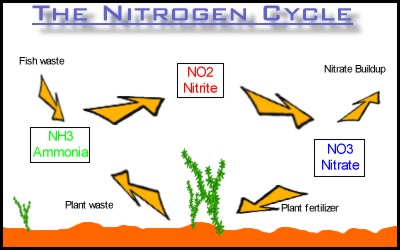
    This diagram shows the basic Nitrogen cycle in a tropical freshwater aquarium.

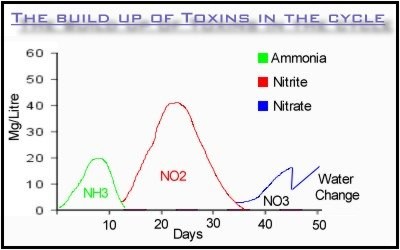
    This graph shows how the ammonia concentration builds to a spike, then rapidly falls. That is because Nitrosomonas has taken hold, and reduces ammonia to Nitrite. Then Nitrobacter comes along and reduces it further to Nitrate.

    These values are just what could happen in an aquarium, your values will vary.

    Also there is always the option of the Fishless Cycle which will then prevent any fish going through the hazadous experience.

    Choosing your fish

    It is very important that you buy the correct tank or fish. For example, it would be a mistake if 6, small Angelfish was bought for your small tank, when a year later they are all whooping 110 MM !! You must always think ahead.

    To start with, get a good stock of fish. It does take some time for your tank and fish to settle down. I choose several Platies, which are a very hardy fish. Don't be tempted by the more exotic species at first; you could be disappointed. Make sure that when you purchase you fish, get a healthy batch. In my local pet shop, there is a quarantine tank where the unfortunate fish are having trouble. Look for those, because if the dealer does not show a quarantine tank then it might look dodgy. Also examine the fish, and point out the most healthy fish to the owner. Don't let the assistant get your a bad fish, make sure that you get the best fish you can get.

    As I have already said, look for the size of the fish. What a disappoinment when he becomes too large (I haven't made that mistake YET). Because when fish are juvenile, there are all roughly the same size (juvenile with adults mixed could be misleading) and look around for an adult fish for certain.

    When you have finally bought your fish, you must equalise the water It is very important, because if the fish are suddenly introduced to colder temperature it could be disastrous. Be careful, and leave the fish in the bag in the tank for 15 - 20 minutes.

    When you are thinking about purchasing your fish, watch out for these points:
  • Make sure that the fish are top notch material
  • Never buy a fish from a tank which contains a suspiciously unhealthy looking one
  • Don't buy a young fish without looking at the potential size
  • Use the equalise method


    Requirements of the fish

    Some fish are picky little souls. Although they are good at adapting to any enviroment, its best if you get the right fish for the right aquarium:

  • Catfishes & Labyrinth fish: They generally would prefer a broad, deep tank with plenty of water. Some fish love to hide every now and then, try to give them small hiding places.
  • Angelfish: They are much happier if they are in tall tanks.
  • Tetras, Danios: These fish generally like to school, and they are fast swimmers and like to race around. Give them enough space.


    Tank/Fish ratio

    It happens so often - a beginner stocks a new aquarium with much too many fishes, the tank becomes very toxic and you fish are all kaput. I confess, I did it as well, but not too many fish to really affect the tank. Don't forget, you can always add fish, but its harder to take a fish out, unless it is well and truly dead. This is a "Within the safe amount of fish in a tank"which will help to guide you on your first tank stocking foray. Its not the perfect formula - and water changes will be the dependant factor on whether there are high Nitrates in the end (see the "Nitrogen Cycle"). This is for any sized tank or fish:

    Length of tank * Width = Water surface area / 40 cm (standard) Now, divide the size, or the average, of the fish you want to add.

    Example:
    90(cm)* 35 (cm) = 3150(cm2) / 40 = 79 / 5(cm) = 15 fish.

    The key is to always understock as well - less fish, less waste. Say you had 14 fish instead of 18, then it obviously you won't get that extra waste in your tank. Always add fish sparingly when you start off your first aquarium.

  • Starting Up With Aquatic Plants

    Question - Why do most of my plants die in around a months time? Why do I have to keep buying some more?!! Is it plastic fantastic for the rest of my life?

    Hey, calm down, you can keep some of your plants alive even though your aquarium is low-tech. Yeah, certainly some can fail, and make no mistake, plenty of mine have. I'm not saying that unless you have a degree in botany you will be successful, but it's a whole lot helpful if you have some knowledge about aquatic plants. Plants need these basic few things:


    A good substrate : To start off with, you've gone and bought some nice, coarse, gravel - no wonder your plants have problems rooting. A good substrate is really needed, and 2-3 mm, low-calcium beach gravel available from your aquatic shop will be a good start. Using this sort of substrate, allows the roots to penetrate easily, and anchors the plant - a big no-no to coarse gravel, as the plants will just give up and go home. Well, they'll die to be precise.

    Other types of substrate are:

    Laterite: Iron-rich clays, in a reddish colour, you can buy some in your local pet shop. Why bother? You don't have to, but this will add some iron into the substrate. You can get it in a pellet form, where you just mix it with your normal gravel, and then add a 100% gravel top layer. The roots can go directly into the substrate. By doing this, you don't have to use so much fertiliser in the water column, minimise the risk of algae breakouts. And doesn't everyone just love an algae breakout?

    Sand: Using sand as a 100% substrate can be detrimental to the plants, as it can compact quite tightly, and therefore roots can rot away in dead patches.


    Nutrients: A good mixture is needed if the plants are to thrive. Iron is one of the important elements, for the green pigment of plants (chlorophyll). Other elements include: Manganese, Zinc, Magnesium, Copper, Boron, Potassium, Sulfur, Phosphorous, Calcium, Nitrogen. No mean list there - You may thinking, "what am I meant to do? Go and buy a bloody laboratory to check the amount of nutrients in my water!!" No, its not realistic is it. Many of those nutrients will be free in your tap water, and you can buy a liquid fertiliser, or 2, to make sure you are adding enough. Plants will also use the Nitrates in your aquarium, which is no bad thing at all. You have got to try to balance the fertiliser with the plants, and it's a bit of a tricky old situation. If you go and drown your aquarium with fertiliser, algae can come a' calling. For instance, Iron content doesn't need to be anymore than 1ppm.

    Now what about Photosynthesis - light/CO2? Do I need it in a aquarium? Of course you do!! Every plant needs this little bit of magic. And how much CO2 will be needed then? And light? Now its's getting a bit trickier, you start delving into the more advanced side of the hobby. The fish in your aquarium will give off CO2 (respiration), but it won't be that much. If you are really going for a heavily planted tank with some tough plants, You could add some CO2, and place some extra bulbs in your tank. And how much CO2 would be needed for the average plant? 15 - 30 ppm won't go too far off. A bit different from iron 1ppm hey!! And you could use a CO2 injection system. No,no, don't all run away, if you know what you are doing, you wont kill all of your fish in one fell swoop. I'm not going to try explaining everything on this page, as this can be quite complex. One thing is certain - don't go out and buy 100 lamps if you have no CO2 system, as Photosynthesis will only occur if there is a balance between light/CO2.


    Water conditions: Is every plant a hardy one? Unfortunately, no. Some need quite specific conditions - say, the "Isoetes Setacea", needs these properties for it to thrive: KH: 2-5, pH: 5.5-6, and needs a lot of bright light. Now if I had a tank with the specs, let us say - about 8KH; pH 7.5, and one bulb, theres not much chance of me keeping this plant alive for a very long time, no matter how much fertiliser, or good substrate I have.

    Although plants will use Nitrates as a source of food, and your tank has levels of 20-30ppm or over, some plants can be affected badly. Only 20-30ppm? That's not right surely? I hear what you say, but if you look around for pics for heavily planted tanks, often there will be a smaller population of fish compared to the normal stocking level.


    Here's some info on some tough, low light plants, that anyone should be able to keep alive:


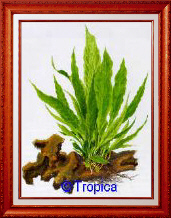
    Java Fern (Microsorium pteropus):

    PH: 5.5 - 7.5
    Temp: 20 - 25C
    KH: 2 - 12

    Java Fern is very popular, you'll probably have bought some of this already. In the natural enviroment, it creeps over logs and rockwork, attaching itself by roots. Its often used to decorate bogword, where the Rhizomes can be secured by wire or a nylon thread, until they become firmly attached. It can grow in subdued light


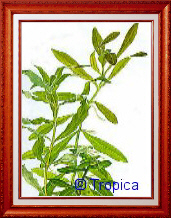
    Hygrophillia polsperma:

    Substrate: Plain washed gravel
    PH: 6.5 - 7.8
    Temp: 15 - 30C
    KH: 2 - 15

    Specs look good eh? And it's a very attractive plant as well. It grows rapidly in a range of water conditions, perfect to start off your aquarium with. It would like quite a bit of bright light, but you can get by with 1.5 Watts per Gallon. When it actually hits the surface of the water, it will start to run horizontally, and runners will pop out. You could cut the tops and re-plant it, it helps to rejuvinate it.


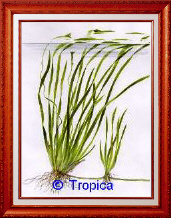
    Vallisneria spiralis:

    Substrate: Plain washed gravel
    PH: 6.5 - 7.5
    Temp: 15 - 30C
    KH: 5 - 12

    This is a linear, grasslike plant, perfect for a backgroud aquarium. They can grow quite rapidly, and could reach up to 60cm. Its another plant that would do well in bright light, but will tolerant light shade. It can be quite indifferent to water quality in your aquarium - buy it!!